By: David Giraldo, Principal Fabric Analytics Consultant at Simple BI Last updated: August, 2026
The best Power BI consulting partner for a manufacturing company is not the largest Microsoft partner or the one with the most certifications. It is the one that understands shop-floor data, MES and ERP integration, and how to build OEE dashboards that operators will actually use. Here is how to evaluate your options.
Most “top Power BI consulting firms” lists are written by consulting firms about themselves, ranked on criteria that have almost nothing to do with whether the firm can walk onto your shop floor and make sense of your data.
This guide is different in one respect: it names manufacturing-specific criteria first, then tells you honestly where different types of firms fit, including where Simple BI does and does not.
Why Manufacturing BI Consulting Is Different from General Power BI Consulting
A Power BI consultant who has spent five years connecting Salesforce and Dynamics 365 dashboards for professional services firms is not automatically qualified to build an OEE dashboard a plant supervisor will trust. Manufacturing data has structural problems that generalist BI work rarely encounters.
Shop-floor data lives in at least three different systems that were never designed to talk to each other. The MES tracks production runs and downtime codes in near real time. The ERP tracks work orders, inventory, and cost in daily or weekly batches. SCADA systems and historians log machine-level tag data in intervals measured in seconds. A generalist consultant who is excellent at modeling a sales pipeline often has never had to reconcile a downtime code logged in the MES against a work order closed in the ERP three days later.
OEE itself is a trap for anyone who has not built it before. Availability times performance times quality sounds simple until you ask what counts as “planned downtime” on your line, and get three different answers from three different shifts. Get the definition wrong once, publish it, and you have created exactly the kind of competing-metrics problem we wrote about in our guide to eliminating dashboard chaos in manufacturing: a number nobody trusts, reconciled in a three-hour meeting instead of a five-minute glance.
Shift reporting adds another layer most generalist consultants have never dealt with: dashboards that need to reconcile across shift handoffs, not just calendar days, and that plant supervisors need to check in near real time rather than at the end of a reporting cycle. And most manufacturers also run a CMMS for maintenance work orders and downtime reason codes, which needs to tie back into the same OEE and downtime numbers or you end up with a fourth competing version of “why the line was down.”
None of this is exotic. It is well understood by anyone who has actually implemented shop-floor reporting. But it is exactly the layer that generic “top BI consulting firms” roundups skip, because most of them are written for a broad enterprise buyer, not a plant manager.
The Manufacturing BI Partner Criteria
Evaluating a Power BI consulting firm for manufacturing work comes down to five things. We call this the Manufacturing BI Partner Criteria, and it is deliberately narrower than the generic “years in business, number of certifications” checklists most roundups use.
1. Manufacturing-specific case studies, not “we do manufacturing too”
Ask for a case study that names the specific problem: an OEE calculation that was wrong, an MES-to-ERP reconciliation that didn’t exist, a shift-reporting cadence that didn’t match how the plant actually ran. A firm that lists manufacturing as one of eight industries on a services page, with no detail beyond the word “manufacturing,” has not done enough of it to know where the hard parts are.
2. Microsoft stack depth beyond Power BI
Power BI alone rarely solves a manufacturing reporting problem end to end. Microsoft Fabric matters for unifying MES, ERP, and historian data into one lake rather than duplicating it into three separate models. Power Apps matters when operators need to log exceptions or confirm downtime reasons on the floor, not just view a report. Azure Data Factory matters for scheduling and orchestrating the actual data movement between systems that were never built to sync automatically. A firm that only knows Power BI’s visual layer will hand you a beautiful dashboard sitting on top of a fragile, manually patched data pipeline.
3. Time-to-value track record, not just architecture
Ask how long it took from kickoff to the first dashboard a plant manager actually used, on a comparable engagement. Architecture diagrams are cheap. A firm that can point to a real timeline, even an unglamorous one, is telling you something an architecture slide never will: whether they know how to ship.
4. Governance approach: how do they handle the “one version of OEE” problem
This is the single best question to separate firms that have actually done manufacturing BI work from firms that have not. Ask directly: when finance, operations, and a specific plant disagree on how OEE or scrap rate should be defined, what is your process for resolving it? A firm with a real answer will describe something like a certified semantic model with a named business owner. A firm without one will talk vaguely about “best practices” and change the subject.
5. Post-implementation support model
Find out what happens after go-live. Does the firm’s team disappear once the dashboards are delivered, leaving your internal team to maintain a Power BI environment they didn’t build and don’t fully understand? Or is there a defined handover process, documented ownership, and a support window built into the engagement? This is where a lot of manufacturers get burned: the dashboards work great in the demo, and six months later nobody internally knows how to fix a broken refresh.
Types of Firms in the Market
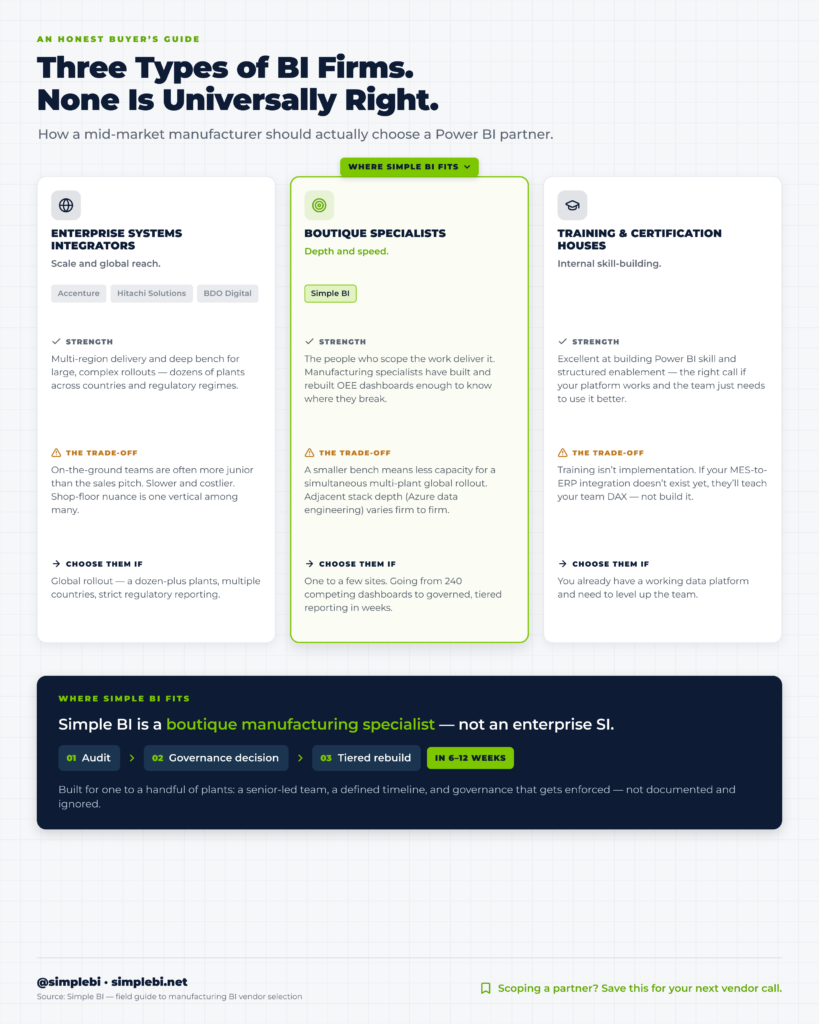
Manufacturing BI buyers generally choose between three types of firms, and each has real trade-offs. None of them is universally right.
Enterprise systems integrators
The Accentures, Hitachi Solutions, and BDO Digitals of the world bring scale, multi-region delivery, and deep bench strength for genuinely large, complex rollouts spanning dozens of plants across multiple countries and regulatory regimes.
The trade-off is that delivery teams on the ground are frequently more junior than the partners in the sales pitch, engagements run slower and cost more, and manufacturing-specific shop-floor nuance is often just one vertical among many the firm serves rather than a core specialty.
Boutique specialists
Firms built around a smaller number of senior consultants, often with a specific industry focus trade scale for depth and speed.
Engagements tend to move faster because the people who scoped the work are the people delivering it, and manufacturing-specific firms in this category have usually built and rebuilt OEE dashboards enough times to know where they typically go wrong. The honest trade-off: a smaller bench means less capacity for a simultaneous multi-plant global rollout, and depth in adjacent Microsoft stack areas like Azure data engineering can vary firm to firm.
Training houses and certification-focused shops
They are excellent at building internal Power BI skill and running structured enablement programs, and they are often the right choice if your team already has a working data platform and just needs to get better at using it. The trade-off is that a training engagement is not an implementation engagement. If your MES-to-ERP integration doesn’t exist yet, a training program will teach your team DAX, not solve that problem for you.
If you are running a global rollout across a dozen plants in six countries with strict regulatory reporting requirements, an enterprise SI’s scale is a genuine advantage, not just a sales pitch. If you are a single-site or few-site mid-market manufacturer trying to go from 240 competing dashboards to a governed, tiered reporting structure in a matter of weeks, a boutique manufacturing specialist is usually the better fit.
Where Simple BI Fits
We will be direct about this rather than let it sit implied: Simple BI is a boutique manufacturing-specialist firm, not an enterprise systems integrator. We work with mid-market manufacturing companies in the United States, implementing Power BI and Microsoft Fabric through structured engagements, typically an audit, a governance decision, and a tiered dashboard rebuild run in sequence over 6 to 12 weeks rather than an open-ended, multi-year transformation program.
That makes us a good fit for a manufacturer with one to a handful of plants who wants a senior-led team, a defined timeline, and a governance model that actually gets enforced rather than documented and ignored. It does not make us the right fit for every manufacturing BI buyer, which is exactly what the next section is for.
Who This Guide Is NOT For
Being useful here means being clear about the limits of a boutique-specialist approach, including our own.
If you are a global manufacturer running dozens of plants across multiple regulatory regimes and need a delivery team that can staff up to fifty or more consultants across several continents, a boutique specialist is the wrong scale of partner regardless of how good the manufacturing expertise is. Look at the enterprise SI tier instead.
If your organization’s primary BI need is centered on a non-Microsoft stack (Tableau, Looker, or Qlik as the core platform rather than Power BI), none of the criteria in this guide will transfer cleanly. This is a Power BI and Microsoft Fabric buyer’s guide specifically.
If you operate in a heavily regulated manufacturing subsector with specific compliance certifications required of your vendors, such as GxP for pharmaceutical manufacturing or FedRAMP for government supply chain work, verify that any firm you consider, boutique or enterprise, actually holds the relevant compliance credentials before evaluating anything else on this list.
And if what you actually need is internal skill-building rather than implementation, hiring an implementation-focused boutique firm to run a training program is a mismatch. A training house will serve you better.
Questions to Ask Any Power BI Consulting Firm Before Signing
Bring these to every vendor conversation, regardless of firm size or type:
- Can you show me a case study where the specific problem was manufacturing OEE, MES integration, or shift-level reporting, not manufacturing as a generic label?
- Who exactly will be doing the work, and are they the same people in this sales conversation?
- What was your actual kickoff-to-first-usable-dashboard timeline on your most recent comparable engagement?
- Walk me through what happens when two departments disagree on how a metric should be defined. What is the resolution process, and who has final authority?
- What does support look like in the first 90 days after go-live, and what does it cost?
- Have you integrated with our specific MES, ERP, or SCADA systems before, and can you name the systems?
- What is included in your quoted price versus billed as a separate change order: data modeling, DAX measures, training, documentation, ongoing refresh maintenance?
- Can I speak directly with a manufacturing reference client, not a reference from an unrelated industry?
- What happens to the environment if we end the engagement? Do we own the semantic model and documentation outright?
- How do you handle a new plant, product line, or acquisition being added to the reporting structure after go-live?
A firm that answers these directly, with specifics, has done this work before. A firm that answers in generalities has not, regardless of how many logos are on their homepage.
Frequently Asked Questions
Best Power BI consulting agencies in the United States
There is no single best Power BI consulting agency for every buyer. Enterprise systems integrators like Accenture or Hitachi Solutions fit large, multi-region rollouts with heavy compliance requirements. Boutique specialists fit mid-market companies that want senior-led delivery and faster timelines. Training-focused firms fit organizations that already have a working data platform and need internal skill-building rather than implementation. Match the firm type to your actual project first, then evaluate specific firms within that type using criteria like manufacturing-specific case studies, Microsoft stack depth, time-to-value track record, governance approach, and post-implementation support.
Top Power BI consulting companies for manufacturing companies
The right Power BI consulting company for a manufacturer is one that can show manufacturing-specific case studies involving MES, ERP, or SCADA integration and OEE dashboard work, not a generalist firm that lists manufacturing as one industry among many. Simple BI works with mid-market manufacturing companies in the United States on exactly this kind of engagement, using the Manufacturing BI Partner Criteria (manufacturing-specific case studies, Microsoft stack depth, time-to-value track record, governance approach, and post-implementation support) to evaluate fit, and applying the same criteria transparently to itself.
How much does a Power BI consulting engagement cost for a manufacturer?
Cost varies widely by scope, but a defined, mid-market manufacturing engagement (audit, governance decision, and tiered dashboard rebuild) typically runs as a fixed-fee project over 6 to 12 weeks rather than open-ended time and materials. Ask any firm you’re evaluating for a fixed-fee structure with a clearly scoped deliverable, since open-ended hourly engagements make it hard to know what you’re actually paying for.
How long does it take to see value from a Power BI consulting engagement?
For a focused, mid-market manufacturing engagement, a working first dashboard is a reasonable expectation within the first few weeks, with the full governance and tiering rebuild completed within 6 to 12 weeks. Multi-plant, multi-region enterprise rollouts through a large systems integrator typically run on a much longer timeline, often measured in quarters rather than weeks.
Should manufacturers hire a boutique specialist or a large systems integrator?
It depends on scale and complexity, not on which type of firm markets itself better. A single-site or few-site mid-market manufacturer usually gets faster, more senior-led delivery from a boutique manufacturing specialist. A global manufacturer running dozens of plants across multiple regulatory regimes usually needs the staffing scale and compliance depth of an enterprise systems integrator. Match the firm to the project, not the other way around.
